publications
publications by categories in reversed chronological order.
2026
- NeurIPS ’26
 SkillsBench: Benchmarking How Well Agent Skills Work Across Diverse TasksXiangyi Li, Yimin Liu, Wenbo Chen, Yixuan Gao, and othersIn Advances in Neural Information Processing Systems, Evaluations and Datasets Track (NeurIPS ’26), 2026NeurIPS 2026 Evaluations and Datasets Track acceptance rate: 25.8% (971/3757)
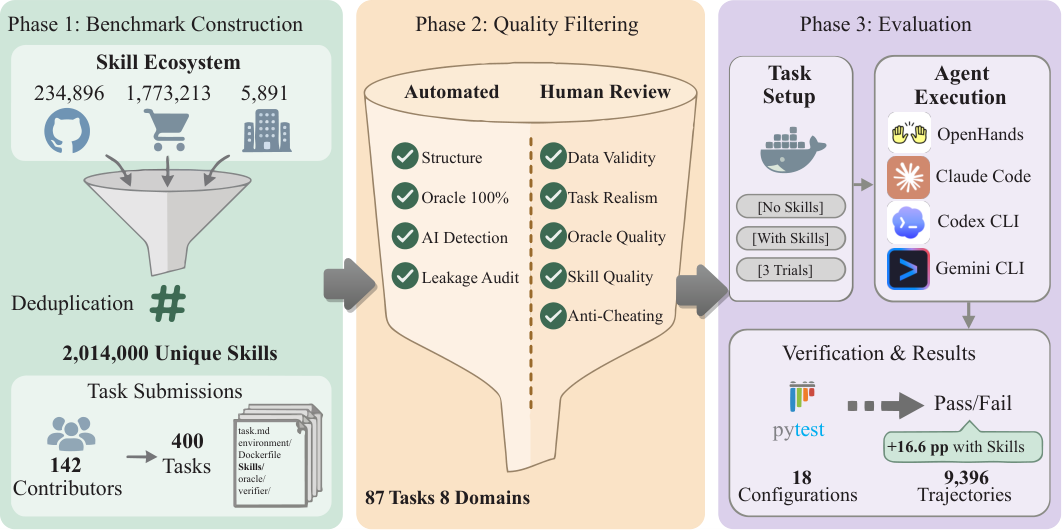
Agent Skills are structured packages of procedural knowledge that augment large language model (LLM) agents at inference time. Despite rapid adoption, there is no standard way to measure whether they actually help. We present SkillsBench, a benchmark whose current inventory contains 87 tasks across 8 domains paired with curated Skills and deterministic verifiers. Our latest aggregate evaluation runs the 87-task benchmark under matched no-Skills and curated-Skills conditions for 18 model-harness configurations. Curated Skills raise the average pass rate from 33.9% to 50.5% (+16.6 percentage points; 25.5% normalized gain), with configuration-level gains ranging from +4.1 to +25.7 pp. Focused Skills with at most three modules outperform larger or exhaustive bundles, and smaller models with Skills can match larger models without them. SkillsBench establishes paired evaluation as the foundation for rigorous measurement of Skill efficacy on agentic, expertise-heavy work.
@inproceedings{li2026skillsbench, title = {SkillsBench: Benchmarking How Well Agent Skills Work Across Diverse Tasks}, author = {Li, Xiangyi and Liu, Yimin and Chen, Wenbo and Gao, Yixuan and others}, booktitle = {Advances in Neural Information Processing Systems, Evaluations and Datasets Track (NeurIPS '26)}, year = {2026}, eprint = {2602.12670}, archiveprefix = {arXiv}, url = {https://arxiv.org/abs/2602.12670}, note = {NeurIPS 2026 Evaluations and Datasets Track acceptance rate: 25.8\% (971/3757)}, } - NeurIPS ’26
 3D Point Splatting for mmWave Radar Novel View SynthesisAdnan Armouti, Yixuan Gao, and Rajalakshmi NandakumarIn Advances in Neural Information Processing Systems (NeurIPS ’26), 2026NeurIPS 2026 Main Track acceptance rate: 25.7% (7900/30709)
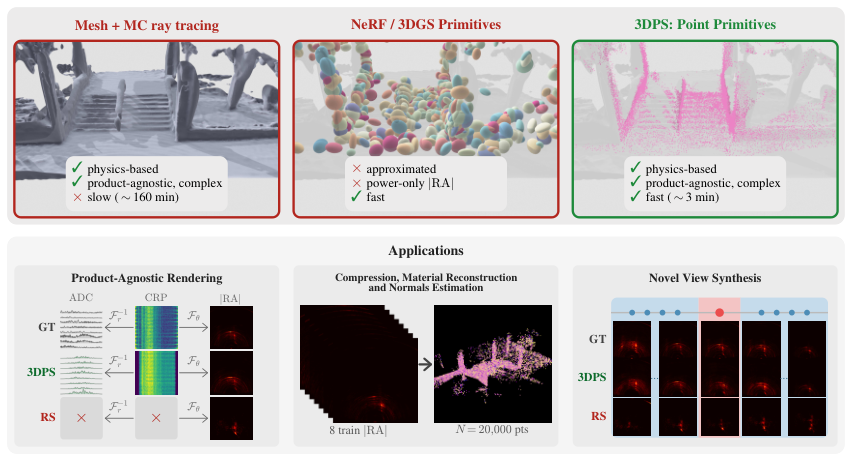
Solving novel view synthesis (NVS) for millimeter-wave (mmWave) radar requires a renderer that is physically faithful, complex-valued, and multi-viewpoint-tractable. No prior method achieves these three properties simultaneously. Differentiable Monte Carlo (MC) ray tracers implement the radar forward model directly with explicit material modeling and complex outputs, but do not scale to the multi-view optimization NVS demands. Optical-NVS ports of NeRF, hash grids, and 3D Gaussians train fast but discard phase and replace explicit material modeling with opaque learned features, restricting them to power-only range-azimuth (RA) magnitudes. We propose 3D Point Splatting (3DPS), the first differentiable point renderer for radar, derived directly from the standard solid-angle form of the radar equation. Each oriented 3D point carries an ITU-R P.2040 material model, evaluated in closed form, with the resulting complex phasor splatted into range bins through a precomputed point spread function (PSF). The complex-valued output makes the renderer product-agnostic. The same optimized scene yields analog-to-digital converter (ADC), complex range profile (CRP), and RA outputs through standard fast Fourier transform (FFT) pipelines without retraining for each format. On six outdoor ColoRadar scenes, 3DPS reaches 0.587 mean Pearson correlation on held-out RA images. This is between 1.7x and 5.2x the three optical-NVS baselines (RadarSplat, Radar Fields, DART). Training takes approximately 3 minutes per scene on a single RTX 4090.
@inproceedings{armouti2026point, title = {3D Point Splatting for mmWave Radar Novel View Synthesis}, author = {Armouti, Adnan and Gao, Yixuan and Nandakumar, Rajalakshmi}, booktitle = {Advances in Neural Information Processing Systems (NeurIPS '26)}, year = {2026}, eprint = {2609.11894}, archiveprefix = {arXiv}, url = {https://arxiv.org/abs/2609.11894}, note = {NeurIPS 2026 Main Track acceptance rate: 25.7\% (7900/30709)}, } - HumanSys ’26
 RadarAgent: Agentic Tool Utilization for Radar-to-Language UnderstandingShuang He, Yixuan Gao, and Rajalakshmi NandakumarIn The 4th International Workshop on Human-Centered Sensing, Modeling, and Intelligent Systems (HumanSys ’26), Oct 2026
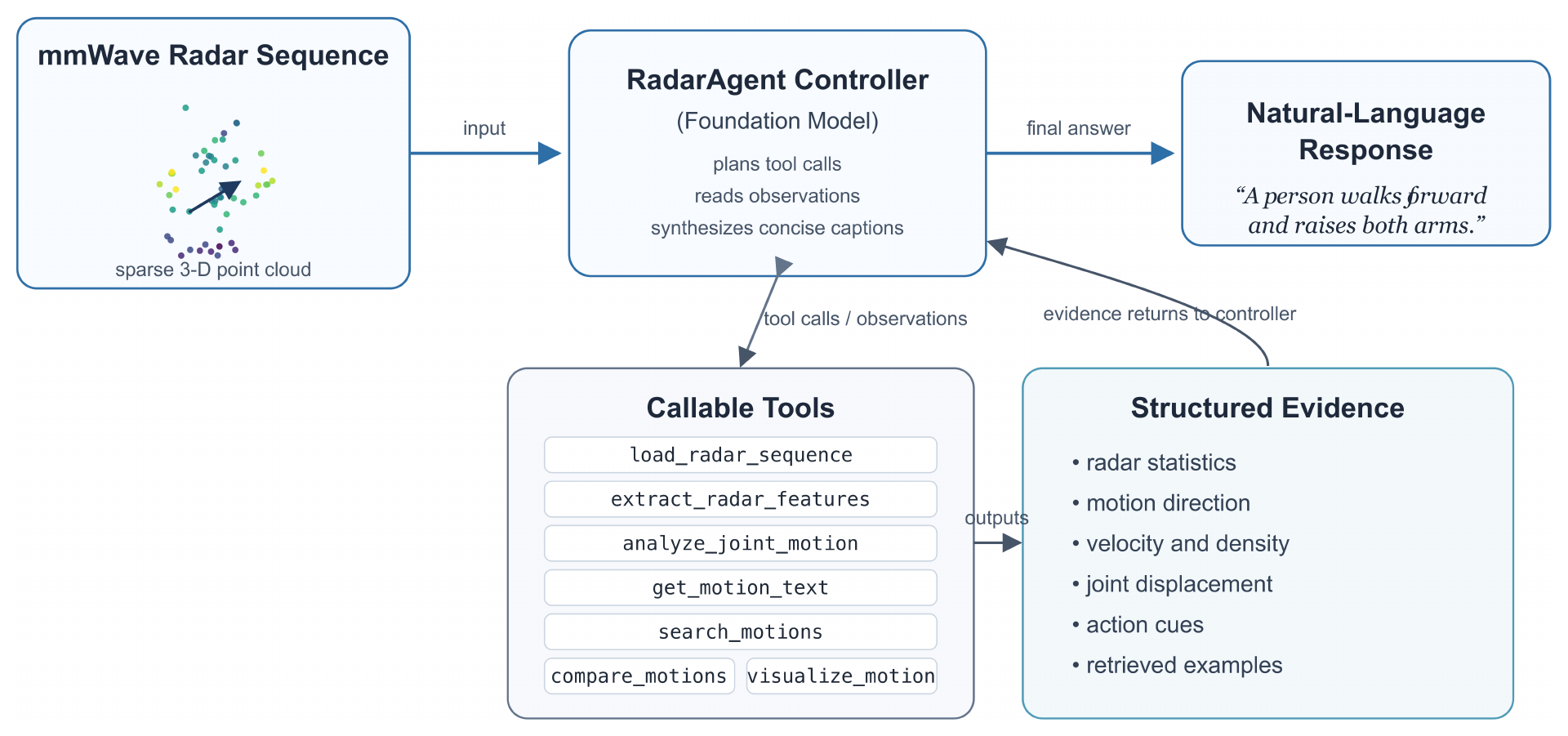
MmWave radar senses human motion without recording appearance or identity, which makes it attractive for privacy-aware applications. However, its raw point clouds and signal-level features are hard for people to read. Existing radar-language models make such data queryable by training a radar tokenizer aligned to a language model, at the cost of specialized pipelines, paired data, and architecture-specific engineering. We present RadarAgent, an agentic framework that exposes radar processing as callable tools and lets a foundation model reason over them to describe motion in natural language, with no radar-token pretraining. In HumanML3D-style motion captioning, it exceeds the RadarLLM baseline on key semantic metrics across several backbones, improving ROUGE-L from 36.0 to 39.6 and BERTScore from 83.3 to 90.7, and tool calling clearly outperforms flat feature prompting.
@inproceedings{he2026radaragent, title = {RadarAgent: Agentic Tool Utilization for Radar-to-Language Understanding}, author = {He, Shuang and Gao, Yixuan and Nandakumar, Rajalakshmi}, booktitle = {The 4th International Workshop on Human-Centered Sensing, Modeling, and Intelligent Systems (HumanSys '26)}, year = {2026}, month = oct, pages = {6 pages}, publisher = {Association for Computing Machinery}, address = {Austin, TX, USA}, doi = {10.1145/3842436.3843801}, url = {https://doi.org/10.1145/3842436.3843801}, } - UIST ’26
 StitchOver: Technical Embroidery on Seamed FabricsZekun Chang, Tianhong Catherine Yu, Yixuan Gao, and Thijs RoumenIn Proceedings of the 39th Annual ACM Symposium on User Interface Software and Technology (UIST ’26), Oct 2026UIST 2026 acceptance rate: 20.1% (253/1259)
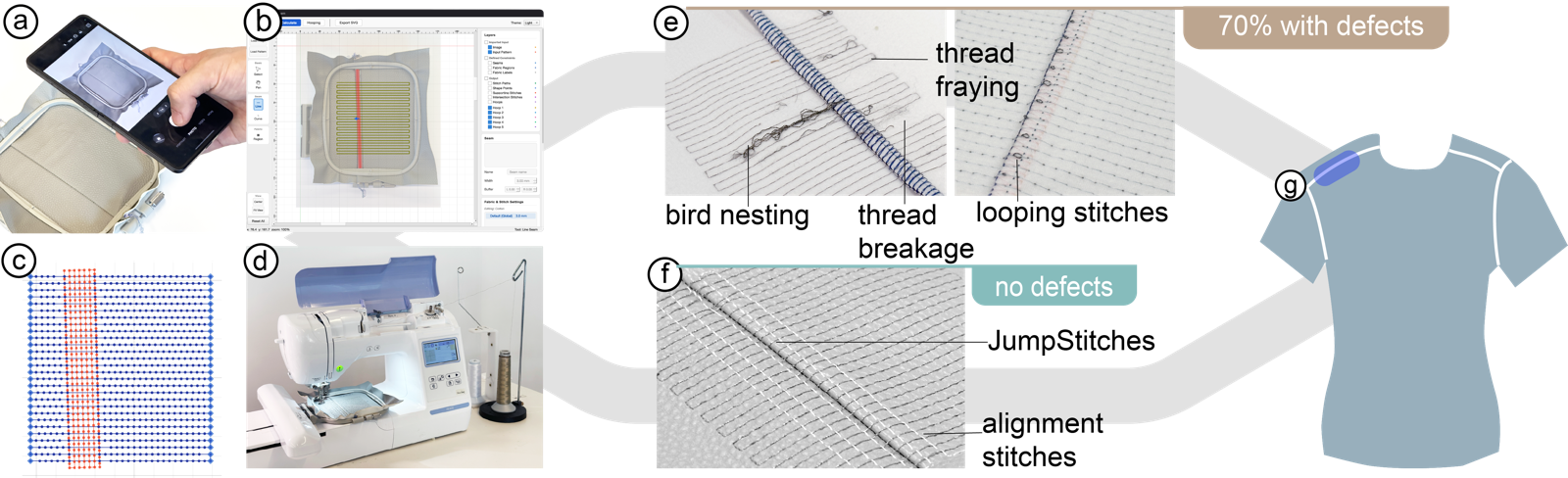
Smart textiles embed interactivity into everyday garments, supporting use cases like always-available sensing for medical applications or sports. Machine embroidery allows integrating functionalities into existing textiles. However, embroidering onto real-world textile goods remains challenging. Textile goods are rarely made of a single homogeneous substrate of fabric, and embroidery with functional materials such as conductive threads requires machines to be more tightly calibrated than for decorative embroidery. In particular, seams, which bring together different substrates, along with machine variability, cause shifts in tension and friction between the functional thread and the textile substrate that frequently lead to defects (70% of samples in our evaluation). We present a technique to reliably embroider on seamed fabric even when using functional threads. Our software tool automatically digitizes user-defined stitch patterns by introducing what we call "JumpStitches" to bypass seam interference. We evaluated our approach under varying machine states (under-tensioned, well-calibrated, and over-tensioned), and across multiple seam and pattern configurations. Our results show that the JumpStitch mechanism eliminates defects, while maintaining conductivity compared to 70% defects without JumpStitches, and even in poorly calibrated machine states continues to work well.
@inproceedings{chang2026stitchover, title = {StitchOver: Technical Embroidery on Seamed Fabrics}, author = {Chang, Zekun and Yu, Tianhong Catherine and Gao, Yixuan and Roumen, Thijs}, booktitle = {Proceedings of the 39th Annual ACM Symposium on User Interface Software and Technology (UIST '26)}, year = {2026}, publisher = {Association for Computing Machinery}, url = {https://arxiv.org/abs/2609.08311}, eprint = {2609.08311}, archiveprefix = {arXiv}, note = {UIST 2026 acceptance rate: 20.1\% (253/1259)}, } - MobiCom ’26
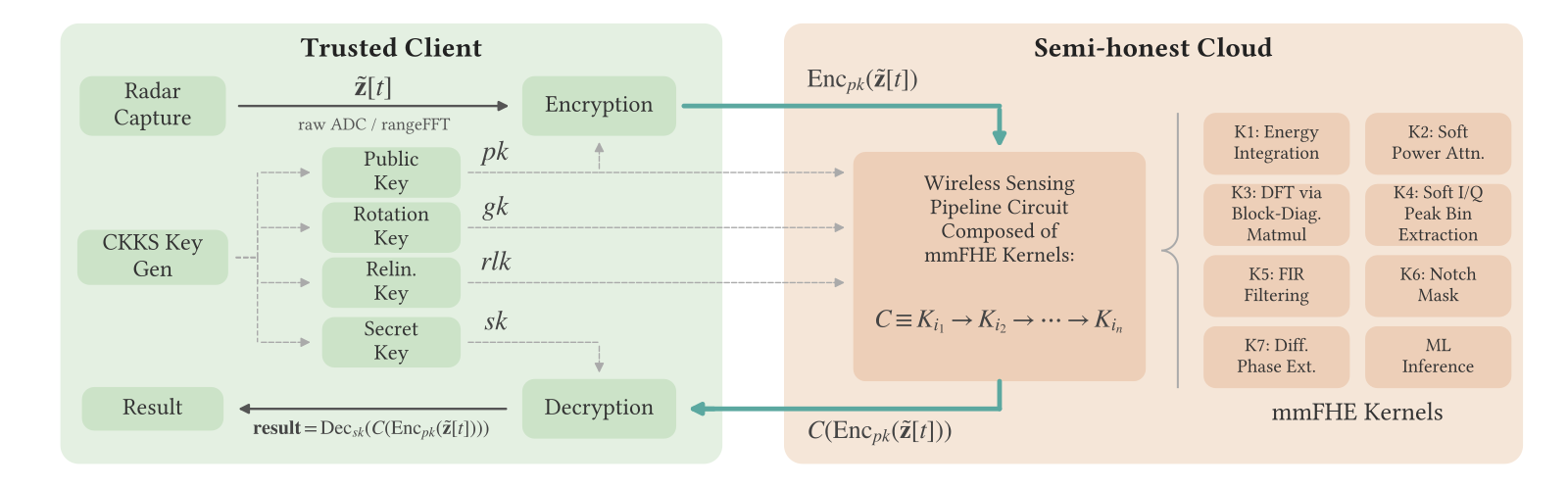 mmFHE: mmWave Sensing with End-to-End Fully Homomorphic EncryptionIn Proceedings of the 32nd Annual International Conference on Mobile Computing and Networking (MobiCom ’26), Oct 2026
We present mmFHE, the first system that executes the entire cloud-side mmWave sensing pipeline including the DSP and ML inference under fully homomorphic encryption (FHE). mmFHE encrypts range profiles on an edge device after lightweight plaintext preprocessing and executes the entire mmWave signal-processing and ML inference pipeline homomorphically on a semi-honest cloud that operates exclusively on ciphertexts. At the core of mmFHE is a library of seven composable, data-oblivious FHE kernels that replace standard DSP routines with fixed arithmetic circuits for different application-specific pipelines. We demonstrate this approach on two representative tasks: vital-sign monitoring and gesture recognition. We formally prove two cryptographic guarantees for any pipeline assembled from this library: input privacy and data obliviousness. These guarantees effectively neutralize various supervised and unsupervised privacy attacks on raw data, including re-identification and data-dependent privacy leakage. Evaluation on three public radar datasets shows that encryption introduces negligible error versus the plaintext pipeline, with 84.5% gesture accuracy (vs. 84.7%). End-to-end cloud GPU latency is 1.21 s per 10 s vital-sign window and 5.76 s per 3 s gesture window. These results establish the initial feasibility of end-to-end mmWave sensing under FHE on commodity hardware.
@inproceedings{ahmed2026mmfhe, title = {mmFHE: mmWave Sensing with End-to-End Fully Homomorphic Encryption}, author = {Ahmed, Tanvir and Gao, Yixuan and Armouti, Adnan and Nandakumar, Rajalakshmi}, booktitle = {Proceedings of the 32nd Annual International Conference on Mobile Computing and Networking (MobiCom '26)}, year = {2026}, publisher = {Association for Computing Machinery}, eprint = {2603.22437}, archiveprefix = {arXiv}, url = {https://arxiv.org/abs/2603.22437}, } - ECCV ’26
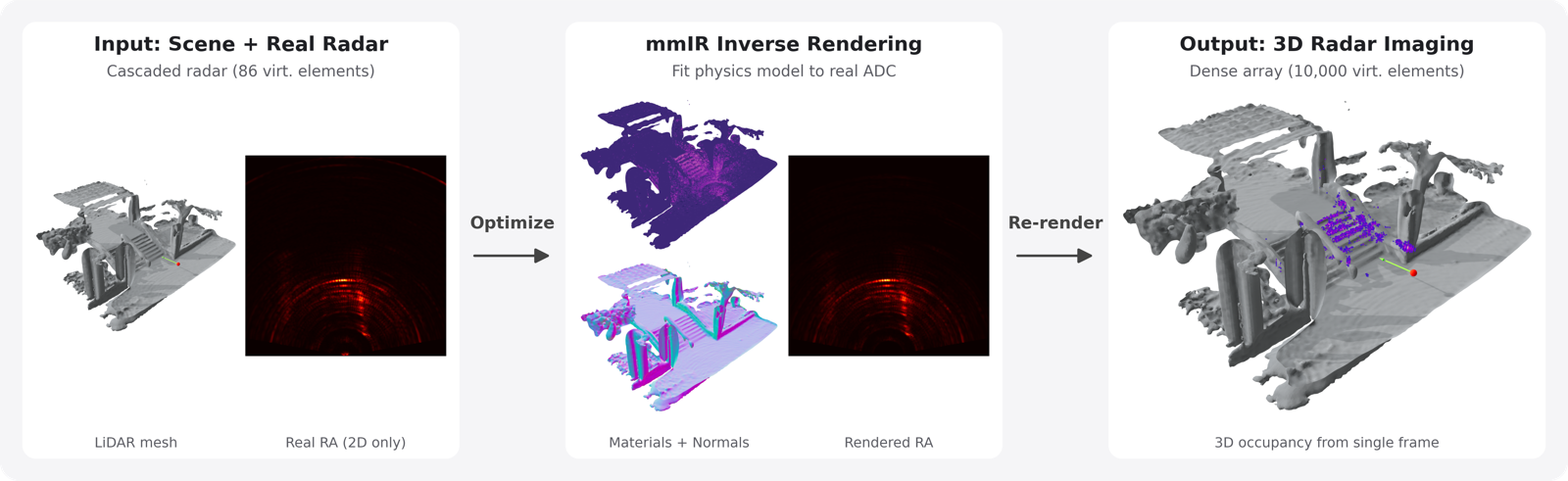 mmIR: Frequency-Space Inverse Rendering for 3D Millimeter-Wave Radar ADC SynthesisAdnan Armouti, Yixuan Gao, and Rajalakshmi NandakumarIn Proceedings of the European Conference on Computer Vision (ECCV ’26), Oct 2026📍 Poster at ECCV 2026 (Thu, Sep 10)
High-resolution 3D radar data is scarce. Commodity mmWave sensors use small antenna arrays that limit angular resolution to several degrees, and existing datasets provide only 2D range–azimuth maps or sparse point clouds rather than raw analog-to-digital converter (ADC) signals. Hardware scaling is expensive, synthetic-aperture scanning is impractical at fleet scale, and learned synthesis methods are bottlenecked by the very data shortage they aim to address. We present mmIR, an open-source differentiable frequency-modulated continuous-wave (FMCW) radar inverse renderer that fits a physics-based forward model to real captures and re-renders from dense virtual apertures to synthesize high-resolution 3D radar data. Because radar resolution is too coarse to recover geometry directly, mmIR performs LiDAR-assisted inverse rendering: using LiDAR-derived meshes as a geometric scaffold, mmIR optimizes per-vertex International Telecommunication Union (ITU) physics materials, vertex normals, and antenna beam patterns through end-to-end automatic differentiation of a phase-coherent multiple-input multiple-output (MIMO) forward model with multi-bounce propagation, polarization, and free-space diffraction. On seven outdoor and six indoor ColoRadar scenes, mmIR achieves 0.914 mean Pearson correlation on range–azimuth maps versus 0.307 for Sionna-RT. Scenes trained on a cascaded imaging radar transfer to a co-located single-chip radar without re-training (0.554 correlation), and dense virtual arrays (100x100 elements) produce single-frame 3D occupancy validated against LiDAR.
@inproceedings{armouti2026mmir,
  title = {mmIR: Frequency-Space Inverse Rendering for 3D Millimeter-Wave Radar ADC Synthesis},
  author = {Armouti, Adnan and Gao, Yixuan and Nandakumar, Rajalakshmi},
  booktitle = {Proceedings of the European Conference on Computer Vision (ECCV '26)},
  year = {2026},
  publisher = {Springer},
  doi = {10.1007/978-3-032-37359-5_9},
  url = {https://doi.org/10.1007/978-3-032-37359-5_9},
  note = {📍 <a href="https://eccv.ecva.net/virtual/2026/poster/5636" target="_blank">Poster at ECCV 2026</a> (Thu, Sep 10)},
}
2025
- HotMobile ’25
 VitalHide: Enabling Privacy-Aware Wireless Sensing of Vital SignsIn Proceedings of the 26th International Workshop on Mobile Computing Systems and Applications (HotMobile ’25), Oct 2025📍 Presented at NYC Privacy Day at Google (Fall 2024) • 🌟 Showcase: Kudos Publication Reader
*Equal contributionWireless sensing of vital signs offers promising opportunities for continuous health monitoring, but raises significant privacy concerns as sensitive biometric data can be inferred from RF signals. VitalHide addresses this challenge by developing privacy-preserving techniques that enable vital sign monitoring while protecting user privacy. Our approach uses differential privacy and secure computation methods to obscure individual measurements while maintaining clinical utility.
@inproceedings{gao2025vitalhide, title = {VitalHide: Enabling Privacy-Aware Wireless Sensing of Vital Signs}, author = {Gao, Yixuan and Ahmed, Tanvir and Chang, Zekun and Roumen, Thijs and Nandakumar, Rajalakshmi}, booktitle = {Proceedings of the 26th International Workshop on Mobile Computing Systems and Applications (HotMobile '25)}, pages = {37--42}, year = {2025}, publisher = {Association for Computing Machinery}, address = {New York, NY, USA}, doi = {10.1145/3708468.3711880}, url = {https://dl.acm.org/doi/10.1145/3708468.3711880}, note = {📍 Presented at <a href="https://rsvp.withgoogle.com/events/nyc-privacy-day-at-google-fall-2024" target="_blank">NYC Privacy Day at Google (Fall 2024)</a> • 🌟 Showcase: <a href="https://www.growkudos.com/publications/10.1145%252F3708468.3711880/reader" target="_blank">Kudos Publication Reader</a><br><strong>*Equal contribution</strong>}, } - SCF ’25
 OriStitch: A Machine Embroidery Workflow to Turn Existing Fabrics into Self-Folding 3D TextilesZekun Chang, Yixuan Gao, Yuta Noma, Shuo Feng, Xinyi Yang, Kazuhiro Shinoda, Tung Ta, Koji Yatani, Tomoyuki Yokota, Takao Someya, Tomohiro Tachi, Yoshihiro Kawahara, Koya Narumi, Francois Guimbretiere, and Thijs RoumenIn Proceedings of the ACM Symposium on Computational Fabrication, , Oct 2025Media Coverage: Cornell Chronicle
OriStitch is a computational fabrication workflow to turn existing flat fabrics into self-folding 3D structures. It uses machine embroidering of functional threads in specific patterns on fabrics, users then apply heat to deform the structure into a target 3D structure. OriStitch is compatible with a range of existing materials (e.g., leather, woven fabric, and denim).We present the design of specific embroidered hinges that fully close under exposure to heat. We discuss the stitch pattern design, thread and fabric selection, and heating conditions. To allow users to create 3D textiles using our hinges, we create a tool to convert 3D meshes to 2D stitch patterns automatically, as well as an end-to-end fabrication and actuation workflow. To validate this workflow, we designed and fabricated a range of application models consisting of up to 338 hinges each (the cap of Figure 1, a handbag, and a vase cover).In technical evaluation, we found that our tool successfully converted 26/28 models found in related papers. We also demonstrate the folding performance across different materials (suede leather, cork, Neoprene, and felt).
@inproceedings{10.1145/3745778.3766666, author = {Chang, Zekun and Gao, Yixuan and Noma, Yuta and Feng, Shuo and Yang, Xinyi and Shinoda, Kazuhiro and Ta, Tung and Yatani, Koji and Yokota, Tomoyuki and Someya, Takao and Tachi, Tomohiro and Kawahara, Yoshihiro and Narumi, Koya and Guimbretiere, Francois and Roumen, Thijs}, title = {OriStitch: A Machine Embroidery Workflow to Turn Existing Fabrics into Self-Folding 3D Textiles}, year = {2025}, isbn = {9798400720345}, publisher = {Association for Computing Machinery}, address = {New York, NY, USA}, url = {https://doi.org/10.1145/3745778.3766666}, doi = {10.1145/3745778.3766666}, booktitle = {Proceedings of the ACM Symposium on Computational Fabrication}, articleno = {21}, numpages = {14}, keywords = {Digital Fabrication, Machine Embroidery, Self-folding, Origami/Kirigami}, location = {}, series = {SCF '25}, note = {Media Coverage: <a href="https://news.cornell.edu/stories/2025/12/seamless-tech-oristitch-threads-computation-and-3d-textiles" target="_blank">Cornell Chronicle</a>}, } - IASA ’25
 Assembly Stethoscope: Detecting Assembly Errors through Frequency Sweeping-A Feasibility StudyIn Proceedings of the 3rd ACM International Workshop on Intelligent Acoustic Systems and Applications (IASA ’25), Hong Kong, China, Oct 2025
Manufacturing assembly processes often involve complex mechanical operations where errors can be costly and difficult to detect. Assembly Stethoscope presents a novel acoustic sensing approach that uses frequency sweeping techniques to identify assembly errors in real-time. Our feasibility study demonstrates how acoustic signatures can reveal improper connections, missing components, and other assembly defects across various manufacturing scenarios.
@inproceedings{bo2025Stethoscope, author = {Liu, Bo and Gao, Yixuan and Li, Yin and Nandakumar, Rajalakshmi and Roumen, Thijs}, title = {Assembly Stethoscope: Detecting Assembly Errors through Frequency Sweeping-A Feasibility Study}, booktitle = {Proceedings of the 3rd ACM International Workshop on Intelligent Acoustic Systems and Applications (IASA '25)}, pages = {19--24}, numpages = {6}, year = {2025}, publisher = {Association for Computing Machinery}, address = {New York, NY, USA}, location = {Hong Kong, China}, doi = {10.1145/3737901.3768368}, } - arXiv
 SoilSound: Smartphone-based Soil Moisture EstimationarXiv preprint arXiv:2509.09823, Oct 2025📋 Under review at a top conference
Soil moisture monitoring is crucial for precision agriculture and environmental monitoring, but current methods require expensive specialized equipment. SoilSound introduces a novel smartphone-based approach that uses acoustic sensing to estimate soil moisture levels. By analyzing how sound propagation changes in different soil conditions, our method enables low-cost, accessible soil moisture measurement using commodity smartphone hardware.
@article{gao2025soilsound, title = {SoilSound: Smartphone-based Soil Moisture Estimation}, author = {Gao, Yixuan and Ahmed, Tanvir and He, Shuang and Cheng, Zhongqi and Nandakumar, Rajalakshmi}, journal = {arXiv preprint arXiv:2509.09823}, year = {2025}, eprint = {2509.09823}, archiveprefix = {arXiv}, primaryclass = {cs.HC}, url = {https://arxiv.org/abs/2509.09823}, note = {📋 Under review at a top conference}, } - arXiv
 PrivyWave: Privacy-Aware Wireless Sensing of HeartbeatarXiv preprint arXiv:2511.02993, Nov 2025📋 Under review at a top conference
Wireless sensing technologies can now detect heartbeats using radio frequency and acoustic signals, raising significant privacy concerns. Existing privacy solutions either protect from all sensing systems indiscriminately preventing any utility or operate post-data collection, failing to enable selective access where authorized devices can monitor while unauthorized ones cannot. We present a key-based physical obfuscation system, PrivyWave, that addresses this challenge by generating controlled decoy heartbeat signals at cryptographically-determined frequencies. Unauthorized sensors receive a mixture of real and decoy signals that are indistinguishable without the secret key, while authorized sensors use the key to filter out decoys and recover accurate measurements. Our evaluation with 13 participants demonstrates effective protection across both sensing modalities: for mmWave radar, unauthorized sensors show 21.3 BPM mean absolute error while authorized sensors maintain a much smaller 5.8 BPM; for acoustic sensing, unauthorized error increases to 42.0 BPM while authorized sensors achieve 9.7 BPM. The system operates across multiple sensing modalities without per-modality customization and provides cryptographic obfuscation guarantees. Performance benchmarks show robust protection across different distances (30-150 cm), orientations (120° field of view), and diverse indoor environments, establishing physical-layer obfuscation as a viable approach for selective privacy in pervasive health monitoring.
@article{gao2025privywave,
  title = {PrivyWave: Privacy-Aware Wireless Sensing of Heartbeat},
  author = {Gao, Yixuan and Ahmed, Tanvir and Chang, Zekun and Roumen, Thijs and Nandakumar, Rajalakshmi},
  journal = {arXiv preprint arXiv:2511.02993},
  year = {2025},
  month = nov,
  eprint = {2511.02993},
  archiveprefix = {arXiv},
  primaryclass = {cs.CR},
  doi = {10.48550/arXiv.2511.02993},
  url = {https://arxiv.org/abs/2511.02993},
  note = {📋 Under review at a top conference},
  dimensions = {true},
}
2024
- EWSN ’24
 Feasibility of Radio Frequency Based Wireless Sensing of Lead Contamination in SoilIn Proceedings of the 21st International Conference on Embedded Wireless Systems and Networks (EWSN ’24), Nov 2024🏆 Best Paper Award
Media Coverage: Cornell Chronicle • Karmactive • phys.org • MSN • American Technion Society • X@CornellGrad • SlashdotLead contamination in soil poses significant health risks, particularly in urban environments and agricultural areas. Traditional soil testing methods are expensive and time-consuming, limiting widespread monitoring. This paper explores the feasibility of using radio frequency (RF) based wireless sensing techniques to detect lead contamination levels in soil samples. We develop a novel sensing approach that leverages the electromagnetic properties of lead-contaminated soil and demonstrate its effectiveness across various soil types and contamination levels.
@inproceedings{gao2024soil,
  title = {Feasibility of Radio Frequency Based Wireless Sensing of Lead Contamination in Soil},
  author = {Gao, Yixuan and Ahmed, Tanvir and Mohammed, Mikhail and Cheng, Zhongqi and Nandakumar, Rajalakshmi},
  booktitle = {Proceedings of the 21st International Conference on Embedded Wireless Systems and Networks (EWSN '24)},
  pages = {99--104},
  year = {2024},
  publisher = {Junction Publishing},
  address = {Abu Dhabi, UAE},
  url = {https://ewsn.org/file-repository/ewsn2024/ewsn24-final99.pdf},
  note = {🏆 Best Paper Award <br><br> Media Coverage: <a href="https://news.cornell.edu/stories/2025/01/new-devices-radio-waves-reveal-lead-contamination-soil" target="_blank">Cornell Chronicle</a> • <a href="https://www.karmactive.com/soilscanner-affordable-device-detects-lead-in-urban-gardens/" target="_blank">Karmactive</a> • <a href="https://phys.org/news/2025-01-device-radio-reveal-contamination-soil.html" target="_blank">phys.org</a> • <a href="https://www.msn.com/en-us/news/technology/new-device-s-radio-waves-reveal-lead-contamination-in-soil/ar-AA1wRqyO" target="_blank">MSN</a> • <a href="https://ats.org/ats-news/new-devices-radio-waves-reveal-lead-contamination-soil/" target="_blank">American Technion Society</a> • <a href="https://x.com/CornellGrad/status/1878804461096722744" target="_blank">X@CornellGrad</a> • <a href="https://science.slashdot.org/story/25/01/04/0044250/new-devices-radio-waves-reveal-lead-contamination-in-soil" target="_blank">Slashdot</a>},
  dimensions = {true},
}
2022
- JMIR Biomed Eng
 Equity-Driven Sensing System for Measuring Skin Tone–Calibrated Peripheral Blood Oxygen Saturation (OptoBeat): Development, Design, and Evaluation StudyAlexander T Adams, Ilan Mandel, Yixuan Gao, Bryan W Heckman, Rajalakshmi Nandakumar, and Tanzeem ChoudhuryJMIR Biomedical Engineering, Nov 2022
Background: Pulse oximetry is a noninvasive method for monitoring blood oxygen saturation that is essential for clinical care. However, existing devices exhibit systematic biases against patients with darker skin tones, leading to healthcare disparities. Objective: We aimed to develop an equity-driven sensing system for measuring skin tone-calibrated peripheral blood oxygen saturation. Methods: We developed OptoBeat, a novel pulse oximetry system that incorporates skin tone measurement and calibration algorithms to provide more accurate oxygen saturation readings across all skin tones. Results: Our evaluation shows improved accuracy and reduced bias across diverse skin tones compared to conventional pulse oximeters. Conclusions: OptoBeat represents a significant step toward more equitable medical sensing technology.
@article{adams2022equity,
  title = {Equity-Driven Sensing System for Measuring Skin Tone--Calibrated Peripheral Blood Oxygen Saturation (OptoBeat): Development, Design, and Evaluation Study},
  author = {Adams, Alexander T and Mandel, Ilan and Gao, Yixuan and Heckman, Bryan W and Nandakumar, Rajalakshmi and Choudhury, Tanzeem},
  journal = {JMIR Biomedical Engineering},
  volume = {7},
  number = {1},
  pages = {e34934},
  year = {2022},
  publisher = {JMIR Publications Inc., Toronto, Canada},
  doi = {10.2196/34934},
  url = {https://biomedeng.jmir.org/2022/1/e34934/},
  dimensions = {true},
}
2018
- Poster: MobiCom ’18
 Analyzing Bitrates in Modern Wi-Fi NetworksYixuan Gao, Ali Abedi, Tim Brecht, and Ramya BhagavatulaIn Proceedings of the 24th Annual International Conference on Mobile Computing and Networking (MobiCom’18), Nov 2018
Modern Wi-Fi networks support multiple transmission rates through adaptive rate selection algorithms. Understanding bitrate selection patterns is crucial for optimizing network performance. This poster presents an analysis of bitrate utilization patterns in contemporary Wi-Fi deployments, examining how different factors influence rate adaptation decisions and network throughput.
@inproceedings{gao2018analyzing,
  title = {Analyzing Bitrates in Modern Wi-Fi Networks},
  author = {Gao, Yixuan and Abedi, Ali and Brecht, Tim and Bhagavatula, Ramya},
  booktitle = {Proceedings of the 24th Annual International Conference on Mobile Computing and Networking (MobiCom'18)},
  pages = {717--719},
  year = {2018},
  address = {New Delhi, India},
  publisher = {Association for Computing Machinery},
  doi = {10.1145/3241539.3267774},
  url = {https://dl.acm.org/doi/10.1145/3241539.3267774},
}